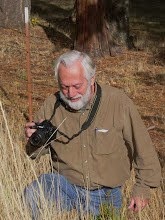
This is the last post about Sunday's sketch-walk in the vicinity of Gilson Creek. The first two posts were mostly about our time spent on a sunny hillside above the railroad tracks and above the last couple hundred yards of Gilson before it enters Spanish Creek. This last post is a group of images made on the hike back toward Oakland Camp. After crossing beneath the railroad tracks, Gilson Creek goes through a deep gully or canyon in a series of beautiful cascades. I've never seen this one dry up at the end of summer even though several other creeks on the east side of Spanish Creek do. Only this one and Tollgate seem to have a pretty good flow until the fall rains begin.
When we approached the mouth of Gilson, I was intrigued by textures of various plants such as in a large stand of Horsetails. This shot is of a fertile frond, the blackish button at the top producing spores and the stem having no side branches. There no sterile fronds yet, but they lack the spore-producing organ at the top, and they have many side branches which look like miniature versions of the main stem. A very lacy look, and easier to see why Horsetails are considered ferns.
The new branches on Black Cottonwood were a bright red, providing a nice contrast with the brownish color of the main trunk. When the tree gets older the bark of the trunk tends to become gray or white and resemble the higher altitude member of the family, the Quaking Aspen.
AS we re-entered the drier oak-pine forest east of Gilson Creek, the ground was covered in leaves of California Black Oak and needles of Ponderosa Pine. The occasional wet spots supported nice patches of moss. This patch has lots of new sporophytes (tan) growing out of the tops of the green gametophytes.
When the trees are wide-spaced, as they were in the open area half way back to camp, one is compelled to pay more attention to their bark. This mature black oak had a beautiful geometric pattern. Click on it for a closer view of the details. The Bluebelly Lizards must love running around on this bark. Easy to grip and I found I could climb a tree like this without relying on branches. Maybe I'm part lizard.
The Ponderosa Pine, sometimes called puzzle tree because of the patterns in its bark, is very impressive when it gets to be four or more feet in diameter. There are some really impressive ones along this trail, including a few that have survived lightening strikes.
This afternoon (Tuesday) was very warm, and I took a nice hike along the Feather River College nature trail. Some photos from that hike will be in my next post, but the narrative will have to wait until tomorrow.
Tuesday, March 12, 2013
Saturday, March 9, 2013
Definitely Spring Today, Part II
After walking a mile or so along Spanish Creek we climbed a hill overlooking the tributary known as Gilson Creek and sat down to do some sketching. It was a dry area, probably having been logged or razed by a forest fire because there were no large trees, and there was lots of colorful shale and other rocks I don't know.
My sketching spot was by this rotting trunk of a Ponderosa Pine. There were lots of large pieces of bark on the ground where a few weeks from now I'll be able to find lots of different bugs, lizards, snakes, and salamanders. As summer approaches and it gets drier, the salamanders are the first to disappear. Then the other species tend to appear in series - first the centipedes and millipedes, then a series of different species of beetles. The Western Fence Lizards, AKA Bluebellies, will be numerous when the bugs are. Today I saw termites, very few centipedes, and one Rove Beetle. Also saw one Dimorphic Flower Longhorn Beetle. Both beetles flew before I could get my camera into position.
Here's the trunk from the stump in the previous photo. During the several years it takes to rot back into soil, a trunk like this provides habitat for lots of different animals, plants, and fungi.
Here are some termites from under one of the large pieces of bark.
I sat down next to this colorful rock with a clump of leaves of Mountain Violet coming out from underneath. This will be one of several species of yellow violets to bloom in this area. I believe this one is Viola purpurea. I decided to make this my first outdoor sketch of the season.
AS we headed back to the car, I found a patch of new leaves, some still red from lack of chlorophyll, of a tiny plant which had bloomed in my driveway every summer, but I haven't been able to identify it. Considering where it grows, it is probably a non-native.
Here's a close-up of a single plant. The flowers, when they come, are only about 1/4 inch across and are pink. Four petals. If anyone can identify it, please let me know. I'll return to this area often and will eventually post some photos of it blooming.
The rocks in this area are not only colorful in their own right, but sport a great variety of colorful lichens.
As we scrambled down the hill back to the Forest Service road. these catkins of White Alder got my attention.
I have a few more photos from today's outing, but will need to catch a night's sleep before I can post them. And tonight we need to turn our clocks ahead one hour, so I might get less sleep than usual.
Definitely Spring Today, Part I
Took an early afternoon hike past Oakland Camp in the area of Gilson Creek and decided that spring has definitely arrived. At first we were seeing only the new green leaves of various wildflowers, but no blooms. The above photo is of one of the early violets, Viola purpurea. Leaves of this violet were all over the south-facing hillside and I expect them to be blooming within another week or so.
Then we saw many clusters of leaves of the California buttercup (above). These get rather tall before they bloom, so I thought it might be a few more weeks before we saw any blooms, then my wife spotted one blooming. Amongst the buttercups there were many early leaves of the Sticky Cinqefoil (below).
This blooming buttercup was only a foot above the ground, so maybe lots of them will be blooming soon. This plant had at least a dozen buds beside the one bloom shown here.
We found a sunny place on a hillside around 100' above the railroad tracks and decided to sit down and do some sketching. My sat right in a patch of the tiny Spring Whitlow Grass. This tiny member of the mustard family, Brassicaceae, is always one of the earliest bloomers around these parts.
The Greenleaf Manzanita were blooming plentifully and didn't look at all like they'd braved a recent snowstorm. Yes, spring is here. Part two of this report will follow shortly.
Then we saw many clusters of leaves of the California buttercup (above). These get rather tall before they bloom, so I thought it might be a few more weeks before we saw any blooms, then my wife spotted one blooming. Amongst the buttercups there were many early leaves of the Sticky Cinqefoil (below).
This blooming buttercup was only a foot above the ground, so maybe lots of them will be blooming soon. This plant had at least a dozen buds beside the one bloom shown here.
The Greenleaf Manzanita were blooming plentifully and didn't look at all like they'd braved a recent snowstorm. Yes, spring is here. Part two of this report will follow shortly.
Apparently the Animals Know....
Whenever there's been a brief warm spell during the past two months, I'd hear a chorus frog or two from the warmed crevices in my firewood pile or from the rock wall across the street from my house. But last night in the vicinity of a small pond on Buck's Lake Road, for the first time this season, I heard hundreds if not thousands creating a steady chorus. It was very loud as I could hear it from 100 yards away. They were the Pacific Chorus Frog, Pseudacris regilla. Then, this morning, before sunrise, I was awakened by a great chorus of birds in my back yard. Off my East-facing deck there is a stand of mixed species of trees: Ponderosa Pine, Douglas-fir, White Fir, California Black Oak, Big-leaf Maple, and numerous shrubs like Cascara Buckthorn and Deer Brush. When spring is well underway I hear this bird chorus every morning. but today was the first time this season. Very exciting. Apparently the animals know something the weatherman doesn't.
Tuesday, March 5, 2013
Complements
We explored trails around Oakland Camp on Sunday and found most snow melted and stirrings of animal activity. I brought home a couple of Stellar's Jay feathers from a site that looked like a jay was somebody's meal. Saw a few spiders, but it's still winter. As I write this, we're expecting another storm tonight probably bringing snow. This morning there were some dramatic clouds and a great rainbow. During the afternoon the wind picked up and the temperature dropped. Looks like lots of invertebrates might have to descend into the soil again.
Sunday, March 3, 2013
More omissions
Lo and behold, I find that two photos intended for my previous post did not load. I might need some tech help to discover whether I'm being careless, or if I can blame some other entity for these omissions. The above photo includes two slugs that were enjoying (I think) hanging from the under surface of a Pecky-cedar board. The local temperature must have been a good 20 degrees or more above the air temperature above. I love how small invertebrates, and even some small vertebrates, identify and take advantage of small spaces with suitable conditions for living when conditions nearby are not.
The photo below shows a Raven that had just taken off from a corral fence. I sent this one to a friend to point out the 45-degree taper at the trailing edge of the tail. I was lucky to capture the bird at all, much less to get a shot barely clear enough to show that feature. I'm not a practiced bird photographer. Ironically, a few minutes later I stopped to check my mail and walked to within 10 feet of a Raven that was busy browsing a dumpster. I could have taken a close-up, but the camera was in my car.
Subscribe to:
Posts (Atom)