When e. e. cummings penned this opening line, he must have been in a place not unlike Table Mountain. Yesterday, my wife and son and I were guests of Richard and Jane, residents of Table Mountain, and our Quincy friends, Paul and Denise and their son, on an all-day hike over the wildly blooming plateau to Phantom Falls. We saw the most amazing display of wildflowers. Took around 300 photos, and I'll be choosing what to post here over the next several days, as well as which ones to send to the Plumas Visitors Bureau's "Bloom Blog." If you have a chance to visit Table Mountain this spring, do it soon. The area dries up very quickly. By the end of April, there will be little or no evidence of the show of color we saw yesterday. Click on any photo to see an enlarged version as well as a caption. I took the advice in cumming's poem and kept my scientist's habit of analysis in low profile and just took in the smells and sounds and rainbow of colors.
Sunday, March 21, 2010
O Sweet Spontaneous Earth...!
When e. e. cummings penned this opening line, he must have been in a place not unlike Table Mountain. Yesterday, my wife and son and I were guests of Richard and Jane, residents of Table Mountain, and our Quincy friends, Paul and Denise and their son, on an all-day hike over the wildly blooming plateau to Phantom Falls. We saw the most amazing display of wildflowers. Took around 300 photos, and I'll be choosing what to post here over the next several days, as well as which ones to send to the Plumas Visitors Bureau's "Bloom Blog." If you have a chance to visit Table Mountain this spring, do it soon. The area dries up very quickly. By the end of April, there will be little or no evidence of the show of color we saw yesterday. Click on any photo to see an enlarged version as well as a caption. I took the advice in cumming's poem and kept my scientist's habit of analysis in low profile and just took in the smells and sounds and rainbow of colors.
Saturday, March 20, 2010
Spring is here!
Arrived home late from wonderful day at Table Mountain. More wildflowers than I've ever seen there before. Long hike to Phantom Falls. Came close to stepping on a rattlesnake. Caught blue-belly lizards and newts and released them after photos. Poppies (two kinds), lupine, goldfields, stick seed and red maids in abundance. The hills looked painted in places. We were hosted by Table Mountain residence so were able to hike across private property and encountered only to or three other people while crowds visited the refuge just south of where we hiked. It was a treat to view so many flowers that had not been trampled. Will post lots of pictures and commentary tomorrow. There should be another two to three weeks of great wildflower viewing before that area starts to dry up. By then, blooming will have moved up into the canyon toward Quincy. As far as Plumas County is concerned, we will have another three to four months of spring wildflower viewing, depending on the elevation.
Friday, March 19, 2010
Ahead of his time!
Quote of the day: "Miracles arise from our ignorance of nature, not from nature itself." Michel Montaigne, 1533-1592. Not only ahead of his time, ahead of our time. Tomorrow I visit Table Mountain where sometimes one can see well over 100 species of flowers blooming at once. "There is grandeur in this view of life...." Darwin. Photos of Table Mountain coming Sunday, 3/21.
Thursday, March 18, 2010
Roadside Awakening
Wednesday, March 17, 2010
Birds Have Joined the Chorus
My perception of how the seasons "should" unfold was undoubtedly set by my childhood experience growing up in New England. Namely, four distinct seasons: a "real" winter with snow, spring with less snow, more rain, and gradual warming with trees budding, wildflowers blooming, and increased animal activity apparent, and so on. You know the drill. It's the stereotypical four seasons of children's storybooks. So, it can be disconcerting to live in California which has such a range of seasonal patterns. While my home town of Quincy has patterns resembling my birthplace, ironically close to Quincy, Massachusetts, I read the San Francisco Chronicle, the only daily paper available here, and it describes the emergence of spring in the Bay Area, anywhere from December when the rains bring a greening of the golden hills, to February, by which time many species of wildflowers are at their peak. Likewise, within an hour of my home in Quincy, there are communities at higher elevations that may not see patterns of spring for another couple of months.
I feel lucky to be able to reminisce via my built-in spring consciousness here in Quincy, yet I can fast forward to the peak of spring, as I will do this weekend, by driving down to Chico or Table Mountain where the wildflowers are already bursting forth, or drive in the other direction to go skiing for another couple of months.
I am working on a CD of Plumas County wildflowers, and I'm debating whether to organize the slide show around plant families, or a chronology of blooming times, or by habitat. The most appealing idea, so far, is revealed in my tentative title, "Chasing Spring Though Plumas County." It would begin with the earliest flowers to bloom at the lowest elevations, around mid-February, then follow the blooming up in elevation along Highway 70, to the 5,000' level, then take a side trip up to the Lakes Basin, around 6,500' where spring doesn't peak until late June or July.
In summary, this morning I heard the birds chattering around my house before dawn for the first time this season. Added to the chorus frogs that emerged a few days earlier, it is an exciting time of year. My house is surrounded by mixed coniferous forest that provides a wide range of habitats. Even though I'm on the edge of town, I have seen bears, foxes, skunks, deer, squirrels, and many species of birds in my yard. It's all good - except when the bears tip over the trash cans or the skunks get too friendly with our dogs and cats.
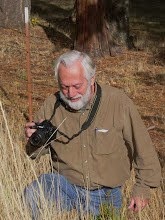
I feel lucky to be able to reminisce via my built-in spring consciousness here in Quincy, yet I can fast forward to the peak of spring, as I will do this weekend, by driving down to Chico or Table Mountain where the wildflowers are already bursting forth, or drive in the other direction to go skiing for another couple of months.
I am working on a CD of Plumas County wildflowers, and I'm debating whether to organize the slide show around plant families, or a chronology of blooming times, or by habitat. The most appealing idea, so far, is revealed in my tentative title, "Chasing Spring Though Plumas County." It would begin with the earliest flowers to bloom at the lowest elevations, around mid-February, then follow the blooming up in elevation along Highway 70, to the 5,000' level, then take a side trip up to the Lakes Basin, around 6,500' where spring doesn't peak until late June or July.
In summary, this morning I heard the birds chattering around my house before dawn for the first time this season. Added to the chorus frogs that emerged a few days earlier, it is an exciting time of year. My house is surrounded by mixed coniferous forest that provides a wide range of habitats. Even though I'm on the edge of town, I have seen bears, foxes, skunks, deer, squirrels, and many species of birds in my yard. It's all good - except when the bears tip over the trash cans or the skunks get too friendly with our dogs and cats.
Tuesday, March 16, 2010
Got Whitlow? Try this!....or not.
In the same area, near the Greenville Y, the pattern of foam on Indian Creek was quite beautiful. Reminded me of a time I was taught how to make marbled paper for the covers of home made books. We just had a rainy period, and now the forcast is for several warm days in a row, so Spring, in terms of wildflower viewing, should arrive on time - this coming Saturday.
Monday, March 15, 2010
The Chorus Has Begun
I knew this frog as the Pacific Coast Tree Frog, Hyla regilla, when I first came to California. I had become familiar with many species of Hyla in the Southeast, but there was only this one on the West Coast. The name has been changed. I suppose it was the result of DNA testing, but it seems it's no longer a tree frog, per se, but a chorus frog and is now Pseudacris regilla. These two were in my front yard and were mostly a mottled gray. This species is quite varied, though, and you'll find them in many shades of gray, brown, and brilliant green. When you come across a pond or puddle where hundreds are singing, it is quite a powerful experience. They may suddenly stop singing when you approach, but sit still for a while and they'll resume their song.
Subscribe to:
Posts (Atom)