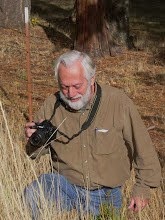
I headed out toward Oakland Camp this afternoon to look for "roadside attractions." Black clouds started to move in and it got a bit too dark for optimum photography. But I managed to find all five local species of milkweeds, three Asclepias and two Apocynum. As a bonus, I found Monarch Butterfly caterpillars and adults. They seemed to be ignoring their best-known host plant, the Showy Milkweed, and were most excited by the Narrow-leaf. More on the status of the milkweeds and other roadside attractions tomorrow.
Tuesday, July 7, 2015
Sunday, July 5, 2015
Too hot to chase bugs for photos...
but they came to me! This elegant moth was in this position by the dish of cat food on the front deck at around 6:50 a.m. I didn't bother to run for the camera as I thought the moth was dead. I came back late in the afternoon, around 5:00, and it hadn't moved, so I was sure it was dead. Got this photo, then poked it. It took off across my yard and disappeared. I guess it was alive! What patience, lasting through the heat of the day.
Around the same time, late in the afternoon, lots of bees gathered on the Lavender by our front fence. A constant frenzy of activity. I took around 20 photos just to get two with bees in focus.
When I approached this paper wasp nest near the ceiing over the front deck, I was pretty sure it was empty, or at least inactive. When I moved in close for a photo, I suddenly had some company.
It was fascinating to watch the wasp's handiwork.
I assume this nest will get bigger. More photo ops to come.
What's left?
I often have occasion to drive along the northern end of Jackson Street where one side of the pavement is lined with houses and the other follows the base of a steep road cut where I do a lot of photography of wildflowers and weeds. I often find myself in an imaginary battle with the road department's mowers to see who gets to have their fun first. A path roughly six feet wide has been treated to at least three or four cycles of weed eating so far this summer. Some of the weeds and wildflowers that are just out of reach manage to live out their complete life cycles, while the ones in the mowed path - the hardy ones, that is - get to stage several comebacks. It's interesting to see their responses to the cutting, often blooming at much earlier stages of their cycles. For example, Salsify, when left along, often exceeds three feet in height before blooming, but after getting mowed a few times, it might bloom when only 6 inches tall. To me, there is some beauty in survival, even among plants generally perceived as ugly. The Daisies along this stretch are nearing the end of their blooming season, and almost every one I viewed close up had one or two petals (i. e., ray flowers) missing. A few had lost all their petals and only dried-up disks (the yellow flowers in the center) remained.
Another survivor of the harshest of human treatments is the red clover. A bonus that comes with this photo is a cute, green grasshopper on the right. I didn't even notice it until I projected the photo on my screen. I wonder how many of them jump out of the way in time when the mowers advance.
Quite a few of these five-petaled, white flowers are now blooming just above the mowed path. Every year I identify this flower then forget what it is. I've forgotten again, but I have a few along my driveway, and I like it.
This healthy specimen of Red Clover doesn't look at all stressed even though at its base, I could see that it had been mowed at least twice. Maybe mowing strengthens its resolve, much like the prairie grasses benefit by appropriate grazing.
Friday, July 3, 2015
The Last Lilies
Not bad for a cell phone! My wife and I took a quick drive to Graeagle this afternoon, and after twelve or thirteen miles of brown, dried-up vegetation at the sides of the road, my attention was grabbed by a great patch of blooming Washington Lilies, Lilium washingtonianum, around a quarter mile east of Lee Summit. There must have been fifty or more blooms, many of them wilted and turning brown. But there were enough fresh-looking ones for some photos. At 4,000' elevation, practically all the lilies are done for the season. I'm hoping to go up to 6,500' and higher within the next few days where it should still be spring. There should still be some lilies at that elevation and also Monkshood.
Nice Legs!
While pulling weeds early this morning, and feeling a little sorry for the pretty ones, I had the pleasure of scaring up some interesting insects. I reflected on a bumper sticker I saw yesterday in the Safeway parking lot that read "Save a bug; mount an entomologist." Turns out that the fellow who drove the car was a biology graduate of UCSB and had taken courses from a fellow zoology graduate of Tulane University who has been a professor at UCSB for a long time. We had a great time reminiscing on our associations with Dr. Armand Kuris. But, back to the topic at hand. Legs. The above grasshopper's rear legs literally glowed in the low angle of morning sunlight. They were translucent while the body was opaque and that made for a dramatic contrast.
Then I came across some very small - perhaps an inch long - Praying Mantises. They were the exact color of the dried grass, so I nearly missed them. They could have ended up in the trash can then transported to a secret place where I dumped the weeds. But I rescued them and hope they find new cover - perhaps in the weeds of the neighbor's yard.
This one was quite aware of being photographed. - seemed to be wanting a "selfie." I obliged.
Wednesday, July 1, 2015
Surviving High Sierra
When the population of our little town quadruples, and the temperature exceeds 100 degrees, the potential for stress is pretty high. I have found the key to not only surviving the weekend, but actually enjoying it, is simply to slow down. Don't try to accomplish what normally takes five minutes (like checking the mail) in less than 15. Park in the shade and walk further to wherever you are going. Or just walk - slowly. Enjoy the greater variety of people for a few days. Enjoy watching other people's excitement. Then photograph roadside weeds.
One of my favorite spots for photographing Showy Milkweed and its insect visitors is now a parking area for festival personnel. In most years, aggressive weed eating eliminates the milkweeds a few days before the people arrive. I took pleasure today in finding a place they missed. In fact, the parking police seemed intrigued by what I was doing, and when I showed them what an incredible fragrance is given off by the milkweed, I think it made their day. As I continued on down the road, I saw in my rear view mirror one of the guys with an official vest leading others to smell the flowers.
Another roadside survivor on Lee Road is the Cinquefoil. It was so hot when I made my stop that neither of these plants had any insect life visiting. They must have been hiding in the shade somewhere.
Last, along Quincy Junction Road, I stopped to photograph the Teasel. I have found that trying to photograph Teasel in this particular spot causes the wind to kick up. Great thing to know on a hot day. It cooled me off a bit, and I got to practice pushing the shutter release on the extremes of the pendulum swing of the plants. Several visiting bicyclists stopped to see what I was doing and inquired about whether I had car trouble then enjoyed taking a closer look at the Teasel. Weeds are so much fun! High Sierra guests - welcome to Quincy, "Gem of the Northern Sierra."
Subscribe to:
Posts (Atom)