Saturday, March 6, 2010

Which Came First, the Snail or the Slug?


I'm glad I'm not a cat because it is said "curiosity killed the cat." Shortly after posting my favorite slug photo yesterday, I came across this one of a garden snail. My mind was flooded with questions as if they arose from some source outside myself. Does the word "snail" sound as exotic to the Frenchman as the word "escargot" apparently does to us? I remember once satisfying the curiosity of my very good physics class in Colorado years ago by preparing escargot over the Bunsen burners in our lab. There was an interesting juxtaposition of odors as the Homemaking Department was next door and they happened to be baking a cake that day. Our different odors were being exchanged through the ventilator system.
My curiosity then switched back to my question of today, Which came first?... We know that snakes evolved from lizards who lost their legs. The fossil record makes that very clear, plus we can find the evidence of lost legs in the boa family in the remnants of a pelvic girdle buried in their hind quarters - although I guess that term no longer applies. We also know that whales evolved from land-dwelling tetrapods. They too have the remnants of a pelvic girdle, among many other bits of evidence. So, I did a little internet research, and, it appears that shells have come and gone a number of times in the history of gastropods. Today, not only do gastropod shells come in all shapes and sizes, but there are borderline species with very tiny visible shells or shells buried beneath the skin so they outwardly resemble slugs. A fascinating feature of the snails with exposed spiral shells is that most are right-handed (dextral) while others are left-handed (sinistral). That brings to mind the association of dextrous with dextral and sinister with sinistral, but don't get me started....
I almost forgot why I included the photo of the tiny frog in this discussion. What struck me is that this tiny vertebrate with its complete anatomy that includes virtually all of the organs we humans have is smaller than one digit of the person holding it! Makes me ponder the relative sizes of things - giant beetles and grasshoppers vs. very tiny fish and amphibians. I have memories of seeing a very large frog eat a very tiny bird, a small mammal, and a golf ball. In the case of the latter, I gently pushed the lump in his stomach forward to relieve him of this non-food, then he promptly ate it again! Next time you get a chance to watch a frog swallow, especially a large frog, watch carefully and you will see how it uses its eyes to swallow. Thoughts to explore on another day.

Friday, March 5, 2010

Feelin' Sluggish Today :)


I was a busy blogger yesterday, lots of things on my mind about attitude. Attitude as it affects education, politics, religion, how we treat each other and the earth. Notice my lack of color? Today, I'll just try to rest up and savor how happy this other fellow looks.

Thursday, March 4, 2010

The Men in Black....

By 1964, I had read Elmer Gantry, but it never occured to me that in the "real world" there were actually people resembling the characters in that novel. I was a graduate student in biology at the University of Florida. My office was in the Florida Museum of Natural History. I was surrounded by evolutionary icons such as a pet Aldabra tortoise, a pet sloth, and an abundance of fossil and recent skeletal material. The fact of organic evolution was never in question. I didn't know at the time that in several counties adjacent to Alachua the teaching of evolution was prohibited in public schools. A brave teacher and some brave kids who wanted to get some quality instruction in the subject managed to invite my ichthyologist friend, Dr. Carter Gilbert, to an after-school meeting in the school library. Dr. Gilbert invited me along for moral support. Dr. Gilbert gave an excellent talk, accompanied by slides, and he entertained questions from the kids who were quite respectful. A group of men in black (who we later learned were pastors) had been standing against the wall in the back of the room. They approached us with Bibles in hand, wielded like weapons, and chastised the professor for this "devil's" talk and said that he would undoubtedly burn in Hell for tainting the minds of these kids. It was obvious to me that these kids were more mature than the pastors. However, I was definitely frightened. This little outpost in Florida was only a few miles away from one of the great centers for the study of evolution.
Around 7 years later I found myself teaching English in a California high school where the very liberal and well-educated faculty could be described as progressive. One of the novels read in 9th-grade English was Salinger's Catcher in the Rye. The cold war was still intense in those days and fear of communist infiltration was common in many communities. I still remember the irony of the cover of that novel being solid red with gold lettering, the exact same format as another popular book of the time, Quotations of Chairman Mao. The men in black, California style, confronted the head of the English Department, then eventually the school board, Bibles in hand, drawing the obvious connection between the communists' plan to corrupt the morals of America's youth and the school having kids read this nasty novel. Yikes!
So, how did these events affect my attitude, especially as regards my current studies of evolution and natural history? Well, the brief version is this: I developed an extreme bias against stupidity.

Late Morning Edition - Attitude


A couple of weeks ago the crocuses were blooming in front of Morning Thunder, then yesterday's snow storm buried them Most of that snow melted off by the afternoon, and this morning I photographed a few that looked only a little worse for the wear. They're "in recovery." The other photo is called "forest paraphernalia" and is an assortment of forest floor items my wife and I gathered while journaling in the forest and placed on a slab of interesting sedimentary rock.
As I get back to musing about attitude and its connection to natural history and what makes a naturalist, I was given a boost by a quote from Bill Watterson's great character Calvin: "You know what we need, Hobbes? We need an attitude. Yeah, you can't be cool if you don't have an attitude." When I was in the midst of studying natural history and ecology many years ago, I was so enthralled, or should I say awed, by the fact of being in college that I thought my professors were gods. I didn't question much of anything they did. Now I look back with some embarrassment at the amount of killing that was inherent in studying natural history. Millions of fish were dropped directly into jars of formalin (formaldehyde gas dissolved in water). Somehow most of us blocked from our consciousness the frantic struggles of those fish as they took their last gulps of oxygenated but toxic water. It had to be painful. The same with frog, insects, and salamanders. Once in a while a larger specimen would thrash so violently it would jump out of the jar and/or splash us with some formalin. I remember having twinges of guilt, even disgust, at those moments, but they would pass as I resumed my duties as apprentice naturalist. We also shot many lizards with "rat" shot from our 22 caliber pistols. Doing this in West Texas deserts seemed appropriate, and we sometimes dressed the part. It was a wasteful practice in that if you were too close, the shot would blast the lizard to smitherines so it was a worthless specimen. If you were not close enough, you would only stun the lizard and it would escape, often badly injured. In the case of bats in caves, we'd often stun them with rat shot. When they then fell from their hanging places on the ceiling stunned, we'd pick them up with leather gloves and put them in burlap bags and later kill them with ether or chloroform. AS for larger mammals, we spent many a night cruising back roads with shotguns and "scientific collectors permits" looking for whatever moved. I remember riding the roof of our van with a shotgun across my lap, and after doing this for several nights in a row, getting so drowsy I almost fell off the roof. I saw lots of amazing wildlife in those days and learned a great deal about all manner of environments from Vlofida to New Mexico and in Old Mexico. I do regret the role of killing. As I pursue similar kinds of knowledge today I go armed with field notebooks and cameras. When I can afford them, I might get a video camera and a directional microphone. It seems to me that Henry Thoreau learned more than most humans about nature by simply looking - looking very carefully and persistently over many years. As an observer, he is one of my heroes, along with Charles Darwin. So, as my ideas about studying natural history evolve, I try to stay open minded, but not so open minded that my brains fall out. :) (graphic cliche)
For my afternoon addendum, I will write about two occasions in which I was confronted by Bible-wielding pastors dressed in black. I have no doubt that these instances helped my attitude evolve.

Further Consideration of Attitude

I'll be adding to this post throughout the day as I have a complicated schedule, culminating in my favorite Quincy event, the monthly Art Walk. I read in a Writers Digest article "The essence of good nature essays is to see what is seldom seen". I thought this photo of leopard lily, Lilium pardalinum Kellogg, exemplifies that thought pretty well. I'm thinking that this spring I'll take lots of photos of the backsides of flowers.
Years ago I made a panoramic drawing of all the fronts of buildings along a couple of blocks of a quaint, historic town in North Carolina. I am tempted to do the same thing here in Quincy because we have a few blocks "downtown" that have that 1800's look. One day I walked the alleys behind all these buildings contemplating a landscape from that point-of-view. Yuck! I gave up the idea quickly. I think the backsides of flowers are a safer bet.
I woke up this morning wondering why I have very strong and pleasant memories of my college class, Vertebrate Natural History, but very vague memories (although not unpleasant) of Invertebrate Natural History. I think it's because the professor in the former had the attitude of a naturalist and the other fellow did not. I liked both professors very much, but the invert prof seemed to be more of an indoor guy. We did lots of microscope and textbook work. I got lots of valuable knowledge from him and have been applying it all my life on walks through the woods, teaching biology, playing with my kids, etc. But the vertebrate guy, Dr. Royal Suttkus, is an ichthyologist, and I think he thought he was a fish. We'd be walking around near some creek or spring on a cold, foggy day, dreaming of being in some cafe, warming our insides and enjoying watching Dr. Suttkus flirt with the waitresses, when suddenly Sutt would appear out of the bushes in swim trunks with a 10' seine in hand and shout "Someone get the other end." More often than not it was I who grabbed the other end and joined him in the frigid water. Little did I know at the time I was making a small contribution to what Sutt eventually built into one of the world's largest ichthyology collections at the Tulane Natural History Museum. Sutt's idea of studying animals was to join them in their natural habitat and really identify with their lives. Sure, he'd go back to the lab and count and measure and attach Latinized names to anything new and publish his findings, but his real joy was obviously being in the water - warm or frigid, clear or stagnant, fresh or salty, safe or infested with water moccasins, if there were fish there he jumped in. I went from being a non-swimmer in high school to becoming a strong swimmer in Dr. Suttkus's company, just to stay alive! Later, I'll reminisce about the shotgun and formaldehyde side of the equation. I have an attitude about those things.

Wednesday, March 3, 2010

Working on my attitude....


When I got up this morning, it was raining. While posting a cryptic comment on the Quincy Writers Group blog, the rain changed to snow - or white rain as my breakfast companion calls it. I discovered, while browsing the A section of my dictionary, that the root of the word attitude is the same as that for aptitude. Interesting. While pausing on "attitude," I noticed "Attleboro" nearby. Interestingly, Attleboro was the neighboring town to Norton, Mass., where I grew up. We definitely had an attitude toward Attleboro. It was much bigger than Norton. In fact, it was a city while we were just a town. Every square inch of Massachusetts is in either a city or a town. Having lived in the West for many years, I've grown accustomed to the fact that the entire state of Massachusetts could fit between many pairs of towns in the West. Another tidbit along these lines: the entire state of Rhode Island could fit twice in the county I live in now. My county has a population of around 22,000 while RI runs around 1,000,000! Anyway, back to the subject of attitude - I'm still working on it. When I was on the high school track team, I was nervous about competing against Attleboro. They had the top long-jumper in the region. I was Norton's long-jumper [We called it the broad jump then.], and I beat their guy! Also, our team beat Attleboro! Reinforced our attitudes! So, as I paged my way back to aptitude, I stumbled across Asheville, NC, a town for which I have great fondness. You see, Asheville is in a region where "attitude" is frowned upon. Yet, it's the location of one of my all-time favorite bookstores, Malaprops. Now there's a name with attitude. Plus, the store was run by a lesbian couple. Great place, right next to the public library and only a couple of blocks from a great pizza place, the Mellow Mushroom, whose motto is "Keep on Shroomin'." Don't ya love that attitude? Another great feature of Asheville which my family has indulged often is the weekly bluegrass gathering in the town square all summer long called "Shindig on the Green." Great times.
Now, before I stray too far from the topic of the day, let me just say I'm working on an essay that will explore the extent to which a "naturalist," which is what I am or aspire to be, is defined by an attitude. What launched me on this exploration was the reminder on some web site or other that the word "attitude" is used in a particular way in aeronautics and space flight. If attitude is the direction in which you are headed with respect to some sort of baseline ("normal" society?) then there must be some sort of analogous way of looking at the attitude of a naturalist. I read in a recent issue of Writers Digest that "The key to the successful nature essay is to see what is not commonly seen." I love that. It's a reminder to me, constantly, in my writing and my photography. Which leads to my final tangent (love that word, too) for the day. When I got to work I was amazed at the response of lots of robins and starlings to this sudden snow storm, so I got out my camera and photographed birds from the warm confines of my office. I've included one photo from a week ago, before the snow returned, that of a nice red willow bush budding. Then I promised myself to finish the essay before the end of the week.

Tuesday, March 2, 2010

March Came in Like a Lion


That Rogers and Hammerstein hit said "March went out like a lion," but I can't wait. It's raining hard and there's a promise (no, a forecast) of more snow this week. In Quincy, that is. It is already snowing elsewhere in the county. The astronomical Spring begins late in March with the vernal equinox, but spring began a month ago down in the Great Valley is we measure it by gass getting green and flowers blooming. Interesting how songs like "June is Bustin' Out All Over" capture our stereotype of the season, yet it only applies to a narrow swath of the temperate zone. These images are meaningless in the southwestern desert or above 10,000 feet in the Rockies and the Sierra. As I've said earlier, one thing I love about my location is that within an hour or so I can go forward and backward in the seasons. Today, snow is only a half hour east but blooming wildflowers are only an hour west. Today I'm posting pictures of flowers I love and of me doing what I love in the spring - photos taken by my wife and son. OK, one was taken in the fall:) Got to get to work. Flower ID notes will be posted this afternoon.
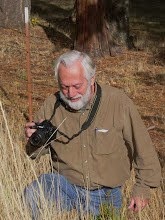
It's now "this afternoon" and I'll add info about the photos and hope that doesn't scramble their positions, which seems to happen often. Feel free to e-mail me for further information or just to comment. The big white lily is Washington Lily, found at the roadsides in many places in Plumas County (and elsewhere) usually above 4,000'. The cluster of Meadow Foam was taken on Table Mountain, around 1500', just outside Oroville, CA. The Leopard Lily is in many places in Plumas County, but is found down to around 2,500'. This cluster was photographed near the Greenville Y, about 10 miles west of Quincy. The gum plant is one of my favorites, a composite, found on roadsides all along Hwys 89 and 70 in Plumas County. It attracts many types of insects. I'm not sure which ones are pollinators. I photographed the Calypso Orchid near Leggett, California, where the locals call it Redwood Orchid. The daisy could be anywhere in the UA, but this one was photographed in a school yard in Quincy. The photos of me were taken in Plumas County, the one with Corn Lily near Snake Lake, just west of
Quincy, the one with Larkspur down in the Feather River Canyon, and the one with my son and the apple press by Indian Falls at our annual Apple Harvest. Technical names and other botanical/geographic information supplied on request.